
A first-hand look at how I actually use AI in marketing on Techfee: the tools, the system, and the real numbers behind it. Built for solo marketers and small teams who want to see what worked before they copy it.
An article that used to eat almost a full day of my time now takes me 1 to 1.5 hours. Same keyword research. Same competitor analysis. Same outline, draft, and scheduling. The difference is that I now use AI in marketing for almost every step of that pipeline, and I verify every output myself before anything ships.
I run Techfee solo. No content team, no agency, no writer on retainer. So when people ask me whether AI can really carry a marketing workload, I am not answering from a webinar slide. I am answering from my own publishing schedule.
This guide walks through exactly how I do it: the two tools I pay for, the system I follow, where AI saved me real hours, and the phase where it wrote garbage until I fixed the way I instructed it. No borrowed case studies. Just what happened on my own projects, documented here on Techfee the way everything on this site is: tested first, written second.
- The real $40 a month AI stack I use, and what each tool is actually for
- The 90/10 system: the exact five-step pipeline behind every Techfee article
- Where AI produced unusable slop, and the two changes that fixed it
- A realistic 30-day plan for starting with AI in marketing, one step at a time
- What is genuinely tested so far on Techfee, and what is still on the roadmap
Last updated: August 19, 2026 by Afraz Alam, Digital Marketing Consultant at afrazalam.com and creator of Techfee. Written after documenting my own AI marketing workflow on Techfee, the exact research, writing, and automation pipeline I run through Claude Pro and ChatGPT Plus, including the $40 monthly stack and the mistakes that shaped the rules I use today.
What Is AI in Marketing?
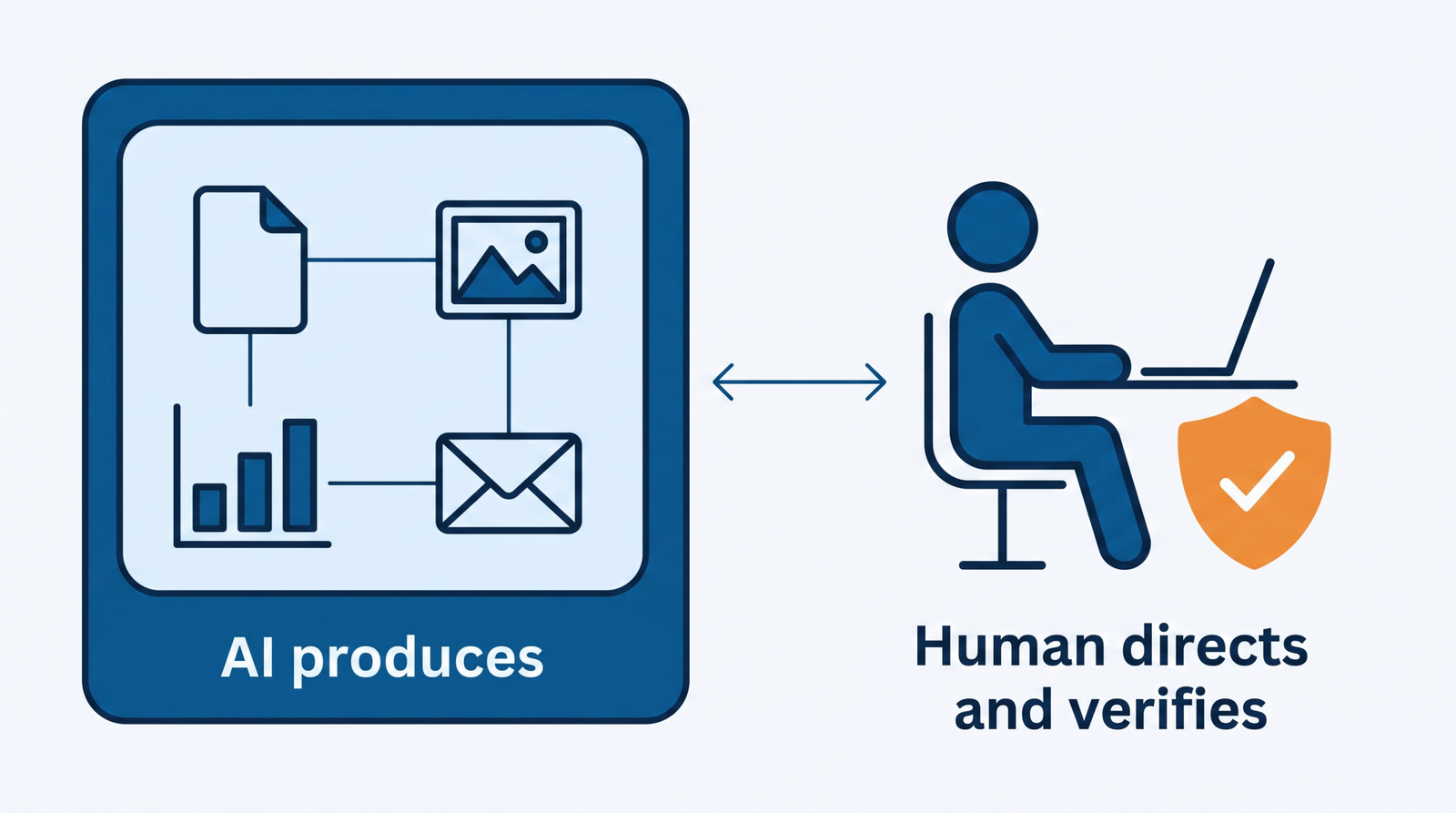
AI in marketing means using artificial intelligence tools to do real marketing work: research, content writing, campaign planning, creatives, and automation. Instead of a person manually doing every step, AI handles the heavy production work while the marketer directs it, verifies the output, and makes the final decisions.
That second half of the definition matters more than the first. Every failure I have had with AI came from skipping the directing and verifying part, not from the tools being weak.
Why Use AI in Marketing?
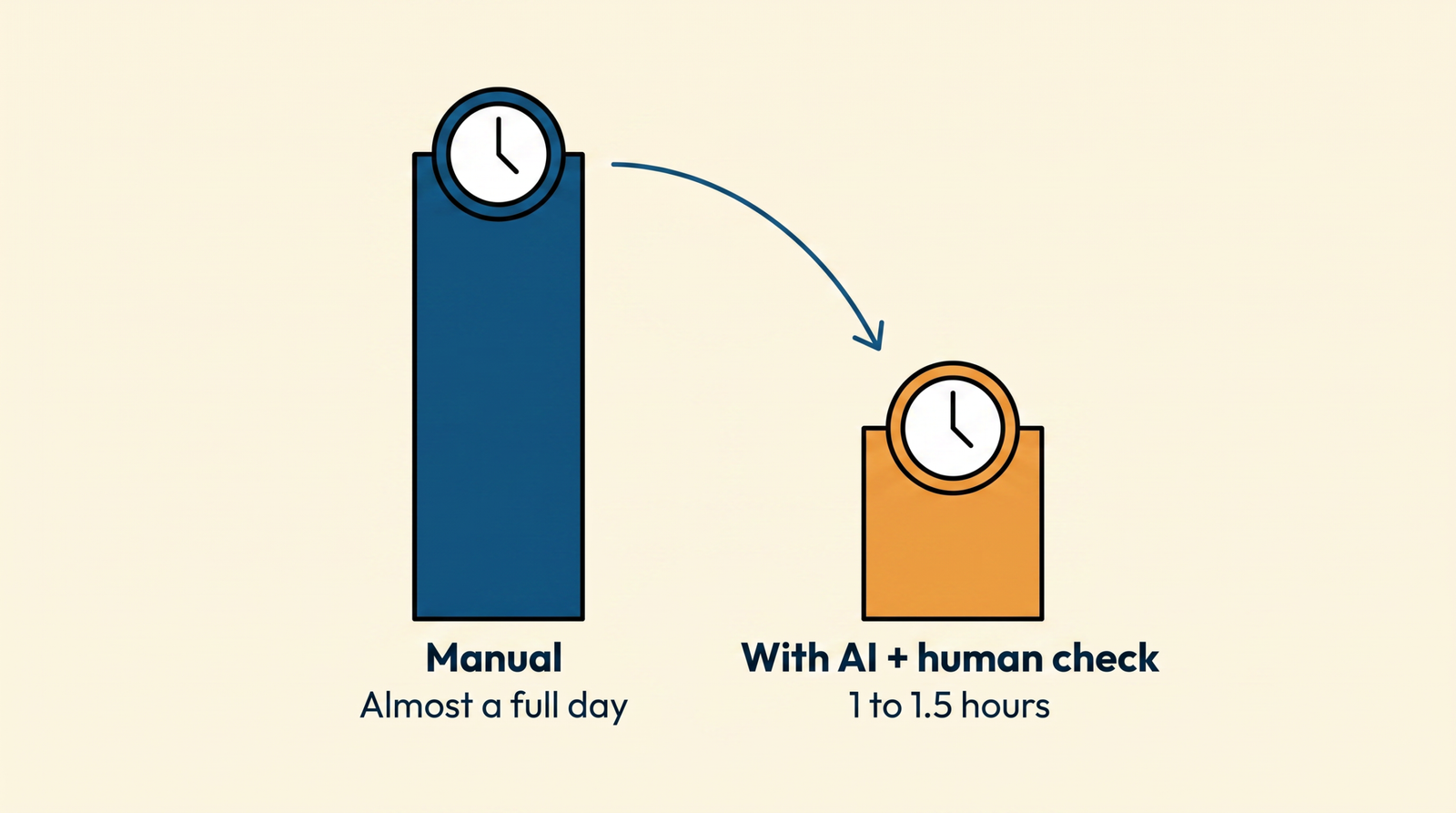
The honest reason to use AI in marketing is time. Work that took me almost a full day, researching competitors, doing keyword analysis, outlining, writing, and scheduling a complete article, now takes 1 to 1.5 hours with proper human verification built in. That is my own rough number from repeated real work, not a vendor benchmark.
For a solo marketer or a small team, that changes what is possible. One person can now run a content operation that used to need a small team.
But here’s the thing. Speed only helps if the output is worth publishing. AI that produces generic content faster just fills the internet with more noise. The whole game is combining AI speed with human judgment, and I will show you the exact system I use for that below.
My Actual Stack and What It Costs
Let me be honest with you: most guides on this topic never tell you what anything costs. So here is my full AI marketing stack, with real prices.
| Tool | Plan | Price | What I use it for |
|---|---|---|---|
| Claude | Claude Pro | $20/month | Deep work: research, article writing, automation, complex multi-step tasks |
| ChatGPT | ChatGPT Plus | $20/month | Fast research and quick discussion on any topic |
Total: $40 a month. That is the entire AI stack behind everything described in this article, and behind Techfee itself.
The split matters. I did not pick two tools to have a backup. They do different jobs. Claude is where I send anything that needs deeper thinking: full research briefs, long-form writing, workflow automation, anything with multiple connected steps. ChatGPT is my speed layer, the place I go when I need a fast answer or want to think out loud about a topic.
One capable AI tool at $20 a month, used properly, replaces more marketing busywork than most software stacks costing far more. But you have to use it properly, which brings me to the system.
The 90/10 System: How I Actually Work With AI
My working principle is simple: AI does roughly 90 percent of the production work, and my 10 percent of human involvement is what makes that 90 percent worth publishing. Neither half works alone.
Here is the exact pipeline I run for every Techfee article, start to finish:
- Competitor research. I study 4 to 5 articles ranking for my target topic to understand what structure and depth the search intent demands.
- Keyword research. Volume, difficulty, and intent for the primary keyword, plus long-tail variations mapped to headings.
- AI-generated outline. I feed the competitor structure and keyword research into Claude and have it build the outline.
- AI draft. Claude writes the full draft against that outline, under hard rules I will explain in the failure section.
- Manual verification. I check tone, intent match, natural keyword placement, and every factual claim. Anything that sounds robotic gets rewritten or re-prompted.
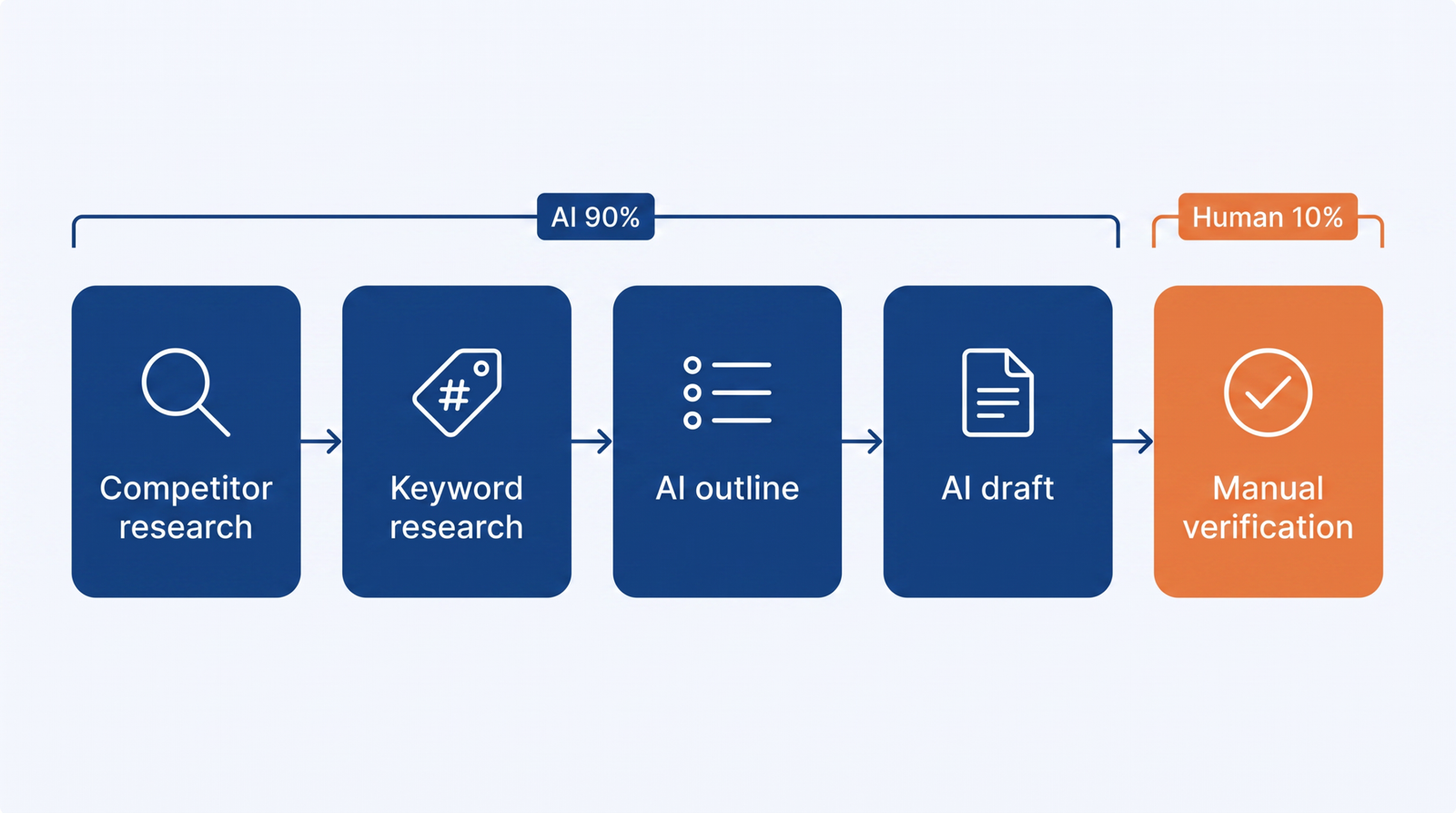
That whole sequence is the 1 to 1.5 hour number I quoted earlier. The verification step is not optional and it is not fast, it is most of my 10 percent.
The 10 percent of human work is the difference between content that ranks and content that gets ignored. Skip it and you are just publishing faster garbage.
How to Use AI in Your Marketing Strategy
You use AI in your marketing strategy by feeding it real data first, your niche, your numbers, your constraints, and having it plan against that instead of asking it to guess. Strategy is where most people assume AI cannot help. In my experience it is one of the strongest use cases, once you stop treating it like a search box.
Using AI for Topic Planning and Competitive Research
Here is a live example, not a hypothetical. The Techfee article you are reading right now was planned with Claude. It pulled keyword data through Ubersuggest, analyzed the top-ranking pages for this topic, found the gaps nobody covered, and produced the complete research brief, all in one working session.
That research found something worth repeating: when I pulled the SERP data for this topic (Ubersuggest, July 2026 SERP data, rechecked in August), the number one ranking result was a forum thread of marketers sharing real experiences. Ahead of major corporate guides. That tells you exactly what search engines are starving for, and it is the reason this article is built on my own tested work instead of theory.
Using AI to Create a Marketing Plan
The workflow that works for me: give the AI your actual situation first. Your niche, your current traffic or audience size, your budget, your available hours per week. Then ask it to plan against those constraints.
The plans that come back from a well-briefed AI are structured, prioritized, and realistic. The plans that come back from “write me a marketing plan” are generic filler. Same tool. The difference is entirely in what you give it.
How to Use Generative AI for Marketing Content
You use generative AI for marketing content by briefing it like a freelancer, not a search engine: give it your voice rules, the real goal, and the format, then edit what comes back before it ships. This is where I have the most tested hours, because content is most of my work on Techfee. Real tasks I have completed with this stack, not planned, completed:
- Full articles, researched, outlined, drafted, and scheduled through the pipeline above
- A video script, written with the same brief-first approach I use for articles
- Marketing creatives, generated with AI instead of manual design work
Across all three, the pattern held: the output quality tracked the quality of my instructions, not the format. A well-briefed reel script came out usable. A vaguely-briefed article came out as slop I threw away. More on that below.
Two rules I follow on every content piece:
- AI drafts, I decide. Nothing publishes without my verification pass. When I cross-check the outputs now, they hold up, but I still check.
- The AI gets my voice rules, not just my topic. Banned phrases, sentence rhythm, structure. Without those rules you get the same interchangeable AI voice as everyone else.
How to Use AI for Marketing Research and Analytics
The direct answer: AI is excellent at collecting and structuring marketing research fast, from keyword data to competitor breakdowns, and a human still needs to judge what the research means before acting on it. I split this work across my two tools deliberately, one for speed and one for depth.
Fast, broad questions go to ChatGPT. When I need a quick read on a topic, a fast explanation, or a first pass at understanding something new, speed wins and it delivers.
Deep, structured research goes to Claude: keyword analysis, SERP breakdowns, competitor gap mapping, the work where one missed detail changes the conclusion. This split, fast tool for breadth and deep tool for accuracy, has been one of the most useful workflow decisions I have made.
One discipline I never skip: any statistic the AI gives me needs a source I can check, or it does not get used. I ask for the source link directly. If the AI cannot provide one, I verify the claim externally or cut it. Unsourced “studies show” claims are fake authority, and readers can smell them.
How to Use AI in Marketing Automation
You use AI in marketing automation by chaining the steps you already do manually, research into outline into draft into schedule, with one fixed human checkpoint that nothing skips. I am moving almost my entire workflow into that model: research, writing, content creation, reel scripts, design creatives, SEO tasks, ad creatives, and distribution. Some of that is running today on Techfee, the rest is being built piece by piece.
The part running today is the content pipeline you have seen throughout this article, and the scheduling step at the end of it. An article goes from topic to scheduled draft in one sitting.
What I have learned so far about automating marketing work: automate the sequence, keep the checkpoint. My pipeline runs on its own momentum, but there is exactly one place where nothing moves forward without me, the verification step. Removing that checkpoint is how automated pipelines quietly publish garbage for weeks before anyone notices.
I am documenting the full automation build, including what breaks, for an upcoming Techfee guide of its own.
If you would rather have this set up and managed for you instead of building it yourself, here is more on how I work with clients.
What AI Got Wrong: My Slop Phase
Here’s the truth about my early results: the AI wrote slop. Generic, hype-heavy, interchangeable content. The kind of writing you scroll past without registering a single sentence.
The problem was not the model. The problem was me. I had not given it proper instructions, so it defaulted to the same bland patterns every unguided AI produces.
Two changes fixed it:
- Hard rules. Banned phrases, banned patterns, required structure, voice guidelines. Written down and enforced on every task, not suggested once and forgotten.
- One instruction that changed everything: share the facts, not the guesswork. Told directly to admit uncertainty instead of inventing confident-sounding filler, the output shifted from plausible fiction to material I could actually verify.
After those two changes, I reached the point where I can trust the output. I still cross-check it, and when I do, it checks out. Trust in AI is not something the tool earns by default. It is something your instructions build.
So if your AI marketing content is not working, my honest advice is to look at your instructions before you blame the tool or buy a new one. That was my entire problem, and fixing it cost nothing.
This is exactly the kind of thing Techfee exists to document. Not just the part where AI worked, but the phase where it did not, and what changed in between.
Is It Okay to Use AI for Marketing?
Yes, it is okay to use AI for marketing, and it is legal. AI is now a standard working tool across the industry, the same way design software and analytics platforms are. The real question is not whether you use AI, but whether a human verifies what it produces before it reaches your audience.
My position after living with this daily: the ethical line is verification and honesty, not the tool. Publishing unverified AI claims is a problem. Using AI to produce work a human has checked, shaped, and stands behind is just modern marketing.
Search engines have said the same thing in their own way. Google’s guidance rewards helpful, reliable content regardless of how it is produced. Quality and accountability are the standard, not the production method. Which is exactly where my 10 percent comes in.
How to Start Using AI in Marketing: A 30-Day Plan
If you are starting from zero, here is the sequence I would follow, based on what actually built the Techfee workflow. One tool, one skill at a time.
Week 1: Pick one tool and one task. Start with a single $20 subscription, not a stack of ten free trials. Use it for one repeated task you already do, like research or first drafts. Learn how it responds before expanding.
Week 2: Write your rules. This is the step everyone skips and the one that matters most. Document your voice, your banned phrases, your structure. Instruct the AI to state facts it can support and admit what it does not know. My output quality changed more from this step than from anything else.
Week 3: Build your first pipeline. Chain the steps of one workflow: research, outline, draft, verify. Run a complete piece of work through it and time yourself. This is where the hours start coming back.
Week 4: Add the second layer. Expand to an adjacent task, a script, a creative, a research report. Keep the same rules and the same verification checkpoint from week 2.
Do not try to automate everything in month one. I got my results by going deep on a small stack with strict rules, not by collecting tools.
FAQ: Using AI in Marketing
How can AI be used in marketing?
AI can handle research, keyword analysis, competitor studies, article and script writing, creative generation, campaign planning, and workflow automation. In my own work it runs the full content pipeline from topic research to a scheduled draft, cutting a near full-day process down to 1 to 1.5 hours with human verification included.
Can AI do marketing for you?
AI can do most of the production work, but not the judgment work. In my workflow AI handles roughly 90 percent of the effort, research, drafting, and structuring, while I direct it, verify facts, and decide what ships. Fully hands-off AI marketing produces generic output that fails quietly. The human checkpoint is what makes it work.
How much does AI marketing cost?
My complete AI marketing stack costs $40 a month: Claude Pro at $20 and ChatGPT Plus at $20. That covers research, writing, creatives, scripts, and automation for a solo operation. You can start with a single $20 subscription. Expensive specialized AI marketing suites are not required to get real results.
Which AI tool is best for marketing?
It depends on the job, and I use two side by side. Claude is stronger for deep, multi-step work like research briefs, long-form writing, and automation. ChatGPT is my pick for fast research and quick answers. If you are starting with one tool, choose based on whether your bottleneck is depth or speed.
What are the disadvantages of AI in marketing?
Left unguided, AI produces generic, hype-filled content and can state guesses as confident facts. Both happened in my early testing. The fixes are strict written instructions and mandatory human verification of every claim before publishing. AI also cannot judge whether content will genuinely serve your audience. That call stays with you.
Is AI marketing content bad for SEO?
Not inherently. Google evaluates whether content is helpful and reliable, not whether AI was involved in producing it. What hurts rankings is the unverified, generic output that unguided AI produces at scale. AI content built on real experience, structured for search intent, and verified by a human can compete. This article is itself an example of that process.
My Verdict After Running My Marketing on AI
AI took my article production from nearly a full day to about an hour and a half, for $40 a month. That is the headline, and it is real. But the win came from the system around the tools, not the tools alone.
Who should use AI in marketing: solo marketers, founders, and small teams doing their own content, research, and creatives. You have the most repetitive production work and the most to gain. Start with one tool and strict rules.
Who should slow down: anyone planning to publish AI output without a verification step. You will save time in week one and lose trust by month three. The 10 percent of human work is not overhead. It is the product.
What I am testing next: pushing more of the pipeline into full automation, ad creatives and distribution included, and documenting exactly what breaks along the way, here on Techfee.
One more thing, so this article does not claim more than it should. Everything above is what I have actually tested: content production, research, and the writing pipeline. AI in marketing goes well beyond that, ad campaigns, email marketing, social media management, video production, YouTube channel management, and I have not tested those yet. Not “coming soon” in the vague sense, genuinely not done. Techfee’s own rule is that nothing gets written up as tested until it has actually been used on real work, so those pieces are not published, because they are not true yet. That is the roadmap, not a disclaimer: each of those areas gets its own tested breakdown on Techfee over time, one at a time, and each one will cover whether the approach delivered what it promised, what it did to efficiency, and what it actually did to output, not what it was supposed to do.
If you want those breakdowns when they publish, join the Techfee newsletter below. No hype, no daily noise. Just what I tested and what actually happened.
And if there is a specific tool or strategy you want tested next, ad platforms, email tools, social schedulers, whatever is on your list, tell me in the comments. I read every one and reply myself, and your comment is a genuine input into what gets picked next, not a formality.
Got a question about any part of this workflow? Ask me. I would rather answer a real question than write another theory piece.

I’m Afraz Alam, a digital marketing consultant and the creator of Techfee. I explore practical AI marketing by testing AI-powered tools, strategies, workflows, automation systems, and marketing processes on real-world tasks. Through hands-on experiments and implementation, I share what works, what fails, and what is actually worth the time, effort, and cost for small and medium businesses, freelancers, creators, and lean marketing teams.


